October 19th, 2026 Len’s Political Note #849 Sweep the Upper Midwest: Minnesota and Wisconsin
2026 General Election
MINNESOTA HAS A SENATE RACE
Peggy Flanagan
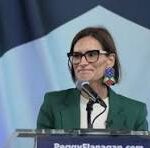
Step back for a minute. Consider Native Americans – then and now. The impact of white colonization of the Americas killed somewhere between 90% and 95% of the Native population. But, a descendent and a defender of the colonizers might say: Most of those deaths were unintentional; the product of disease.
From the perspective of the victims….. Does intent matter a lot? Or is the consequence crucial regardless of intent? And, of course, there was plenty of murderous intent besides.
While Peggy Flanagan of Minnesota and Mary Peltola of Alaska may well be the first two Native American women to become US Senators, the first man to achieve that position was Charles Curtis of Kansas. A member of the Kaw tribe who was born in North Topeka in 1860, at the age of 8, he rode with a translator across the prairie to the governor where the translator asked for help against what proved to be a Comanche show of force. A gregarious horse lover, Charles Curtis was an old fashioned conservative popular in rural areas. He operated in government as if he were a horse trader. He was elected to Congress in 1892 and to the US Senate in 1906. He became the Senate Majority Leader in 1924. And he was Herbert Hoover’s Vice President in 1928 – the only Native American and the only person of color to achieve that position. His appointed successor Henry Allen was defeated in a special election in 1930 by former County Attorney George S. McGill who is the only Democratic US Senator elected by popular vote – so far. (Take a moment. Consider a Donation to Adam Hamilton, a Democrat who could be elected in Kansas in 2026.)
And now: Peggy Flanagan
Peggy Flanagan says we need more Native voices. Actually, we need her voice and her history. Her mom, Patricia Elizabeth Flannagan, worked for the DFL (The Democratic Farmer Labor Party which is Minnesota’s expanded Democratic Party) her entire life. Her dad, Marvin Manypenny, who was not part of the household, was an activist. He advocated for Native American land rights and sovereignty.
Peggy Flanagan grew up knowing what it meant to receive food assistance; what it meant to receive public welfare, Medicaid, and Section 8 housing. She graduated from one of Minnesota’s finest public high schools. and went to the University of Minnesota where she majored in child psychology and minored in American Indian Studies. A non-academic minor was Paul Wellston’s campaign for the US Senate. Another was time spent as s volunteer organizer for the urban Native American community,
Peggy Flanagan grew up knowing what it meant to be a member of the White Earth Band of the Ojibwe tribe. After college she went to work for the Minnesota Council of Churches, serving as a liaison between the local public schools and Native American families. That was such frustrating work, she ran for the Minneapolis school board herself.
Twenty-five years old, Peggy Flanagan joined a field of six candidates; came in first in a contest for which the top three vote getters were elected. During her four years plus on the school board, tenure that began in 2005, she had her agenda regarding the school district’s treatment of minority students and the achievement gap between white students and students of color. She also had to face the reality of hard times: budgetary limits, school closures, teacher layoffs, and administrative restructuring.
Finished with the school board in 2011, Peggy Flanagan began learning more about state politics as she served as the Executive Director of the Minnesota Chapter of the Children’s Defense Fund. In 2014, she could claim a successful role lobbying the legislature to pass an increase in the minimum wage.
She was elected to the Minnesota House of Representatives after a special election in November of 2015. In 2016, she earned national attention speaking at the Democratic National Convention that nominated Hillary Clinton.
In 2018, with the other two Native American women in the Minnesota House, Peggy Flanagan proposed the creation of a state task force to examine reasons for the large number of murdered and otherwise missing Native American women.
In 2017, Peggy Flanagan was selected by then Congressman Tim Walz to be on the ticket with him. He was the Democratic nominee for Governor; she would be his Lt. Governor. After eight years of leading committees and generally doing the progressive work for Governor Tim Walz, Peggy Flanagan faced a tough primary for Governor.
Congresswoman Angie Craig is a gay woman who had won a tough legal fight to keep her own child when living in the south. She and her partner left after that experience, even left the country, and eventually separated. Angie Craig found herself in Minneapolis, working in Human Resources at St. Jude’s Hospital. Eventually she led the department. A business-oriented Congresswoman, she outraised Peggy Flanagan $12.7 million to $6.5 million. Peggy Flanagan was more successful in gathering endorsements from progressives. Among her endorsers were: Sen. Elizabeth Warren (MA), Sen Ed Markey (MA), Sen. Bernie Sanders (VT), Sen Chris Murphy (CT), Sem. Chris Van Hollen (MD), Sen Jeff Merkley (OR) Sen Martin Heinrich (NM). Don’t forget: the retiring incumbent: Sen Tina Smith (MN) or another well-known retiree: Sen Al Franken (MN). That deluge of progressive endorsees helped Peggy Flanagan swamp Angie Craig by a 59-40 majority.
Now Peggy Flanagan needs to defeat the Republican nominee, Peggy Flanagan’s political views were a help in the primary: Her expressed willingness to block military aid to Israel in order to change its behavior in Gaza. Her support for universal Medical Insurance through Medicare for All. Her further efforts regarding Medicare – coverage for vision, hearing, and dental as well as regulation of insurance company practices regarding prior authorization of treatment. Her support for a complete and total overhaul of ICE. Her support for transgender rights. Her view of the Iran War as illegal. All those views were targets for Republicans.
Michele Tafoya is Peggy Flanagan’s Republican opponent. Originally from California, with California college degrees, her Minnesota connection was as a radio announcer for the University of Minnesota women’s basketball and for the Minnesota Vikings of the NFL. After her local reporting, she become a figure on ABC and ESPN sports, usually reporting from football sidelines. She became a fixture on NBC Sunday Night Football in 2011 and left sports in 2022.
In 2022, Michele Tafoya was campaign co-chair for the Republican candidate for Governor of Minnesota. She continued as a political commentator, describing herself as a “Pro-choice conservative with libertarian leanings.” She has survived the occasional ridiculous claim – that 30% of Californians are homeless, for instance. She has her own version of Teflon which has allowed her to simply deny her comment that she was “embarrassed to say” she lived in Minnesota. She responds to comments about living part-time in Florida with no awkwardness. She simply argues that Florida was a great example of conservative governance.
There was a point when it appeared as if Peggy Flanagan’s campaign was just not taking off. It could be she had an electioneering learning curve to master. Previously, she had been elected to a school board, by the very small constituency of a state representative, and then as the bottom of the ticket in the Governor/Lt. Governor race. In mid-September a poll found the two candidates for the Senate EVEN at 42%. Since then, in late September/Early October, Peggy Flanagan led, but not by enough: 46-45 and 46-44. Two polls were reported on October 9. The one that was funded by the Democrats had Peggy Flanagan leading 50-42. The other, reporting on Registered Voters rather than Likely Voters, by a neutral pollster had Peggy Flanagan leading 45-41.
Peggy Flanagan is definitely not out of the woods. She needs your help. DONATE to her campaign.
There is a Minnesota campaign for Governor, too. It includes a familiar name.

US Senator Amy Klobuchar, for reasons we can speculate about, announced her candidacy for Governor of Minnesota in late June. 2026. Coordinated with Governor Tim Walz, she announced the day after Tim Walz told the press he would not run. In her video, Amy Klobuchar took on the core issue. She said “I’m running for every one…for every Minnesotan who wants ICE and its abusive tactics out of the state we love.”
Referring to the fraud scandal that was Trump’s pretext to use Minnesota as a test case of ICE swarming a state, particularly its leading cities, she said: “the people who steal taxpayer money [should] go to jail ….as [Minnesotans] root out the fraud.”
In January, 2026 Tim Walz gave everyone a clue that he might not run for a third term when he said “I don’t think any governor in history has had to fight a war against the federal government every single day.” Tim Walz and the people of Minnesota who led the day in and day out resistance, including two civilians who were killed by ICE, have, more or less, won that war. In February, Trump withdrew 700 ICE agent and announced that the “Operation Metro Surge” was coming to an end. More withdrawals would follow.
Amy Klobuchar has five clear priorities. First is Lower Costs for Minnesotans (with plans for reducing health care, housing, and child care costs). Second is: Make Government Accountable and Root Out Fraud: with plans to eliminate bureaucratic tie ups that make people jump through hoops to start a business and use of technology to get the government work done efficiently.
Amy Klobuchar’s Republican opponent is unlikely to give her trouble. Lisa Demuth does have some appeal. Speaker of the Minnesota House since 2022. She is the first Black legislator and the first Republican woman to serve in that role. She has led her fellow Republicans effectively. Amy Klobuchar has been elected consistently to the US Senate by Minnesotans. In 2012 by a 61-35 margin, in 2018 by a 60-36 margin, and in 2024 by a 56-41 margin. As for the polls for this race for Governor, there were a few polls of Likely Voters in September. Amy Klobuchar led them all: 50-40, 47-45, and 47-40. That second poll was by a Republican firm. There was a poll of Registered Voters in October. Amy Klobuchar led that one, too: 48-39.
It is a small thing. Probably, with the decision to run for Governor, Amy Klobuchar is giving up on plans to run for President. If, however, she thinks differently, she was one of a few women whose critics described her as unable run her office. She will beat that criticism if she runs her state well.
Do not be complacent about the Governor race. DONATE to Amy Klobuchar’s campaign.
WISCONSIN HAS A TIGHT CAMPAIGN FOR GOVERNOR. NEITHER US SENATOR IS UP FOR ELECTION IN NOVEMBER.
Governor – David Crowley

sMilwaukee County Executive David Crowley demonstrated his nimbleness while we all have received a lesson in the uncertainty of politics as he obtained the Democratic nomination for Governor. As Democratic candidates, including David Crowley, dropped out of the race for Governor, they left State Assemblywoman Francesca Hong as the leading contender. Her affiliation with the Democratic Socialists and unfortunate comments from her youth made her vulnerable. Governor Tony Evers asked David Crowley to get back in the race and he did. He and Francesca Hong agreed to support whoever won the primary. They agreed that defeating Republican Tom Tiffany was the most important thing. David Crowley won the primary by a half point.
David Crowley was born and raised in Milwaukee to parents whose substance addiction left them so distracted and so financially strapped that they lost their home and were evicted at least twice more from other residences. David Crowley never lost his sense of himself. He graduated from high school and enrolled in the University of Wisconsin – Milwaukee. Politics was the distraction that delayed him from finishing his degree, a degree he completed as an adult and a successful politician.
In 2010, in his early twenties, he joined Russ Feingold’s campaign for reelection to the US Senate. Feingold lost the race. David Crowley found his profession. He got a job as an aide to County Supervisor Nikiya Harris Dodd. When she was elected to the State Senate in 2012, David Crowley continued working for her in Madison.
In February, 2016, David Crowley won the primary for the open seat for Assembly District 17. In this overwhelmingly Democratic district, he had no opposition in the general election. David Crowley would work in Madison for a little longer, but as an elected official. He was easily reelected in 2018. In 2020, he focused on a run for Milwaukee County Executive. The run off was close; David Crowley won by 1,026 votes.
As County Executive, David Crowley looked for allies to help deal with Milwaukee County’s financial and pandemic crisis. Those allies included the recently elected Governor Tony Evers and the League of Wisconsin Municipalities. The upshot solution included a .4 percent increase in the County sales tax. The County received $11 million in opioid settlement funds which were distributed to various county programs. Among the innovations were vending machines that distributed fentanyl test strips and naloxone which reversed the deadly effect of fentanyl. David Crowley worked on housing affordability which included a goal to provide legal counsel for anyone facing eviction. He signed a climate action plan committing the county to net zero carbon emissions by 2050.
sWhen Republican nominee Tom Tiffany was a state legislator, he supported mining and logging without restraint and was proud to be an enemy of the Wisconsin League of Conservation voters. He described Barack Obama’s EPA as radical. Tiffany supported Trump’s effort to overturn the results of the 2020 election and supports continued efforts to re-re-examine that election. In Congress, Tiffany has been a supporter of Trump’s tariffs. Although, he voted to support disclosure of the Epstein files, he has denounced Democratic efforts to actually obtain disclosure of the files.
At the end of September and the beginning of October, there were two polls of Likely Voters. David Crowley was ahead in both. He led one poll 49-46; the other 49-44. That second poll was funded by a Democratic leaning organization. See Len’s Political Note #836
OTHER STATE-WIDE RACES IN MICHIGAN
Attorney General: Inc Keith Ellison.
Twelve years ago, Keith Ellison wrote an autobiography. He was a Congressman
then; the first Muslim ever elected to Congress. Subsequently, he was elected Minnesota’s Attorney General in 2018 and reelected in 2022.
Keith Ellison tells his family history in his memoir – “My Country, “Tis of Thee”. He writes about his parents in Detroit. He notes that his mother’s ancestor from the early 19th century, Augustine Metoyer’s portrait hangs in a Catholic Church in an isolated Louisiana area now filled with Metoyer’s descendants. Clida Martinez, Keith Ellison’s mother grew up in that community of relatives.
Clida Martinez’ father (Keith Ellison’s grandfather) was part-Spanish, part Black, a descendant of Metoyer and a slave whose name and African tribe are still remembered. The slave was Coincoin of the Ewe people. Freed and given some acres of land, the land where eventually Clida Martinez, an only child, was born, she was sent to the Holy Rosary Institute. Her family sent her to a boarding school for her education and her safety. Her part Black activist grandfather was sought by the Klan and her parents wanted her away from danger. She moved on to Xavier University in New Orleans where she studied medical technology. She met Leonard Ellison Sr., Keith Ellison’s father, when visiting a cousin at the University of Michigan.
Keith Ellison’s other grandfather Zollie Ellison was born in Georgia. Zollie’s father was born a slave. Like many Black Georgians, Zollie left left the South hoping to work in a factory. He earned and saved enough money to buy rental properties and to open a store. He was a tough man and a vulnerable one. He was tough enough to throw a man attempting to rob his store through a window. He was always vulnerable, despite his prosperity, because he never learned to read.
His two sons would prosper, but first they loved Detroit’s Black culture, its music, entertainment, and excitement. Keith Ellison’s father quit school at 15 to join the military. Discharged, he returned to finish high school, then went to Wayne State supported by the GI Bill. He went to the University of Michigan medical school and became a psychiatrist – a colorful one. A natty dresser, he drove fancy cars and had the help of his wife, who managed the practice. Unfortunately, he suffered a debilitating stroke. After her husband’s stroke, Keith Ellison’s mom trained as a social worker. She worked for the Court system for 20 years and died of Covid leaving her disabled husband and five sons – a doctor, three attorneys, and one who was both a pastor and an attorney.
In the early 1980s, Keith Ellison was an angry young man, railing against racism and the unfairness of the social structure. His family told him that “Any jackass can kick a barn down; it takes a carpenter to build it back up.”
Keith Ellison found a different way to rebel. His mom was a leading figure in the local Catholic church; Keith Ellison converted to Islam. His generous mother’s response was to acknowledge that her children had different paths to spirituality. Rebellious as he may have been, he graduated from Wayne State and continued on to the University of Minnesota Law School where he became still another kind of convert. He became a Minnesotan.
In Minnesota, Keith Ellison worked as a litigator for a firm, became executive director for the non-profit Legal Rights Center, then returned to litigation for a different firm. In 2002, he was elected to the Minnesota House of Representatives. While in the House, he brought an ethics complaint against a Republican House Member for falsifying history. That state rep had denied that homosexuals were persecuted by the Nazis.
Keith Ellison was elected to the US House of Representatives in 2006. In Congress, an ally of Barney Frank, he pressed for and eventually succeeded in prohibiting excessive credit card interest for people who had previously been through bankruptcy.
sIn 2018, he announced plans to run for Attorney General in Minnesota. Each of Keith Ellison’s Attorney General races have been close. In 2018, he won 49-45; in 2022 he won 50.4 to 49.5. There have been no major polls of the 2026 race, but a recent poll sponsored by a radio station had Republican Ron Schutz leading 45-43. Schutz has picked up Trump’s complaint about fraud in Minnesota public services and is blaming Keith Ellison for a failure to prosecute. Keep Keith Ellison in the game. DONATE to his campaign
Secretary of State: Inc Steve Simon
Steve Simon is a local who ventured out of state to get his BA from Tufts in Massachusetts. He returned to the University of Minnesota for his law degree after which he worked for Hubert Humphrey III. He practiced law for thirteen years in Minneapolis, was elected to the state House of Representatives in 2004 and kept on getting reelected. He ran for Secretary of State in 2014 and was narrowly elected. He was reelected in 2018 and 2022 by larger margins. He gave some thought to running for governor in 2026, but decided against it. Having never lost an election, he is running for reelection as Secretary of State, perhaps making himself a permanent fixture in that role. That’s not a bad thing. We could use more progressive thinking politicians with integrity serving permanently as Secretaries of State and overseeing elections. His election is not automatic, though. His opponent is Tad Jude, a former state legislator whose candidacies for higher office have not been successful. Yet, in a September poll by a local radio and television station, Jude trailed by only 4 points, 3 points better than the August poll. If you want to be sure, DONATE to Steve Simon’s campaign.
State Auditor: Zach Filipovich
Zach Filipovich is a former At-Large Duluth City Councilor and a practicing accountant with an MBA from the University of Minnesota-Duluth. He won the DFL primary for this position which is open because DFL incumbent Julie Blaha retired. In the primary and the general election, Zach Flipovich has emphasized he was the only accountant running. The Republican nominee is Scott Jensen, a former state Senator and a medical doctor who ran unsuccessfully for Governor in 2022. While running for Governor, he sought to give credence to Donald Trump’s claim that he won the 2020 election and, without providing any evidence of wrongdoing, said Secretary of State Steve Simon should go to jail. DONATE to Zach Flipovich’s campaign.
WISCONSIN’S OTHER STATE-WIDE RACES
Attorney General: Josh Kaul
Josh Kaul’s mom is a former state attorney general; his stepfather is a cop. His father was South Asian. Josh Kaul went to Yale for his BA and then to Stanford Law School. After working in the federal prosecutor’s office in Baltimore, he returned home to practice law in Madison. In 2018, he won a narrow victory in his run for Attorney General and was more easily reelected in 2022. During the summer of 2024, Josh Kaul brought charges against Trump operatives in connection with their efforts to produce improper Wisconsin electoral college members for 2021. Josh Kaul gave thought to running for governor, but chose to run for a third term as Attorney General instead. His Republican opponent is Eric Toney, a County District Attorney who was his opponent in 2022. Josh Kaul won that race narrowly 50.7 to 49.3. Help Josh Kaul ensure a victory in 2026. DONATE
Over the years, Wisconsin has moved responsibilities for both Secretary of State and State Treasurer to other state agencies. They remain as elective positions and are important symbolically, if nothing else.
sSecretary of State: JoCasta Zamarripa
JoCasta Zamarripa ‘s grandmother, a migrant farm worker in Texas, left for Wisconsin thinking that she could make a better life there. Her mother grew up in Milwaukee and was a single parent. She and a sister, who had a passion for politics, raised JoCasta, who became the first member of the family to go to college. JoCasta Zamarripa graduated from a Roman Catholic high school and then from the University of Wisconsin-Milwaukee with a Bachelor of Fine Arts. Along the way, she came to understand herself as bi-sexual. After college she worked for Planned Parenthood and volunteered for Fair Wisconsin which advocated for the rights of members of the LGBTQ community. In 2010, she was elected as a State Rep and kept getting reelected. She served as the Democratic Caucus Vice-Chair and sought to allow undocumented graduates of Wisconsin high schools to pay in-state tuition at state colleges and technical schools. She also sought to allow the undocumented to get driver’s licenses. In 2020, she was elected to the Milwaukee Common Council where she continued to advocate for members of the LGBTQ community and for the undocumented. She was unopposed in the Democratic Primary, but will be faced with both a Republican and a Green Party opponent in the General Election. Jay Schroeder, the Republican nominee describes himself as an “authentic MAGA activist.” He would eliminate the bipartisan Wisconsin Elections Commission which oversees elections. Currently, the Wisconsin Secretary of State’s only election responsibility is to validate the certification of Wisconsin’s electoral votes. Schroeder lost to Democrat Doug La Follette in a contest for Secretary of State in 2018 and sought, but did not get, the Republican nomination for the same job in 2022. Even with the limited role this office offers, it is important that he be defeated. DONATE to JoCasta Samarripa.
State Treasurer. Yee Lang Xiong.
Yee Lang Xiong was born in Wisconsin to Hmong refugee parents. His parents worked in factories while he grew up to work on behalf of refugees. He is the Executive Director of New Beginnings for Refugees. In the past, he has been a school board treasurer and a village trustee. The Treasurer oversees school trust funds, low interest infrastructure loans, and unclaimed funds. The Republican incumbent John Leiber explains he demonstrates his conservatism by not wanting to add responsibilities to the office. DONATE. Yee Lang Xion would be a good addition to the elected officers of Wisconsin.
A MINNESOTA CONGRESSIONAL RACE TO NOTE
Minnesota 01 Jake Johnson
Democrats have an upset in the making. This district, once represented by Governor Tim Walz, has a Republican lean, but has been welcoming to moderate and interesting Democrats. Jake Johnson is a math teacher and a union rep.
Jake Johnson is one of eleven children. His dad was a garbage collector; his mom a meter reader. Things got tougher financially after his parents divorced. His mom married a disabled veteran and, Jake Johnson recalls, they could not have gotten through each month without SNAP and Medicaid. He credits those federal programs and his community, his church, and his teachers for keeping him on track.
Jake Johnson went to the local high school, Stewartville High. The school is about twelve miles south of the high school in Rochester, Minnesota where he now teaches. Stewartville was a 9-12 school with roughly six hundred students. Jake Johnson played football, basketball, and baseball. There, at Stewartville High School, he met his future wife.
Relying on odd jobs and Pell grants, he was able to go to the University of Wisconsin – La Crosse, just across the Mississippi River from Minnesota. He and Molly got married after they graduated. Jake Johnson got the first job he applied for – teaching math in Rochester, Minnesota. Math teachers are pretty scarce. He might have been the only applicant,
He has been teaching for twenty years and has taught the range – from AP calculus to remedial math. He made it a personal project to help kids in danger of dropping out of school stay in school. Some did not just stay in school. Jake Johnson was able to move some into his accelerated math classes with impressive success.
He has been his local union’s Government Relations Coordinator, a role that involved him in state-wide budget and policy issues. He has also been a member of the local collective bargaining team where he learned some more about budgets and policy.
Among the photographs on his website is one of him speaking with students in class and another with him and Molly and their four boys sitting on their front steps. Jake Johnson could not be more comfortable in both of those places.
If he is elected, he will find a way to be comfortable as a Member of Congress. He says he can bring down costs by eliminating Trump’s tariffs and cutting red tape to make home construction simpler. He will work on eliminating corruption by preventing Members of Congress from trading stocks, by establishing term limits, and prohibiting pardons for donors and family members.
He is going to have to defeat the Republican incumbent first. Brad Finstad is a Trumper. A former head of a Center for Rural Policy, Trump appointed him the state Director for the US Department of Agriculture. With Trump out of office, after briefly heading the state Turkey Growers Association, he was elected to Congress. You can’t represent Minnesota in Congress without a consciousness of the presence of ICE. Finstad is sure – ICE was only arresting the worst of the worst.
sPull off an upset. There was an old poll funded by Republicans and reported out in April. Finstad led 54-44. But in September, in a new poll funded by Democrats Jake Johnson led 47-46. DONATE. Elect a new Congressman who is the kind of teacher the people of Minnesota 01 would love to have. See Len’s Political Note #790.
WISCONSIN CONGRESSIONAL RACES OF NOTE
Wisconsin 01.
Mitchell Berman is a nurse and a Democrat and grew up going to Church. Mitchell Berman is the most recent Democrat to target this district once represented by Republican leader Paul Ryan, now represented by Republican Bryan Steil. Nate Silver includes the district among the country’s closest races.
Mitchell Berman’s dad built a roofing business, his mom worked in a factory. Mitchell Berman was the first in the family to attend college. With his degree, he became an emergency room nurse. His first venture into politics was as an angry parent – protesting his local school board’ firing a school principal because he was gay. At least that was the way it seemed. They acted in a meeting that violated the open meeting law.
Mitchell Berman’s run for congress has been grounded in the Big Beautiful Bill’s consequences for health care – cuts in Medicaid, cutbacks in support for ACA insurance premium subsidies, and in further health care spending cutbacks likely to lead to consolidation of hospitals. His focus is relentless and, in this political world dominated by Trump, Bryan Steil cannot quite escape that focus by pressing his support for business and for pro-Wisconsin trade policies.
Months ago, a poll of Likely Voters had Steil leading 50-41. The next three polls of Likely Voters were funded by Democrats. Steil led Mitchell Berman in August 49-48. In September the two candidates were tied at 48. And in early October, Mitchell Berman led 48-47.
Steil’s lead in the financial race is a lot bigger than that. On July 22, Steil had $6.3 million available to spend on his campaign. Mitchell Berman had $150,000. You can give up or you can DONATE to Mitchell Berman.
Wisconsin 03 Toss up
Wisconsin 03 is among the fifteen Republican held seats Cook identifies as a Toss up. The Wisconsin 03 incumbent Derrick Van Orden was elected in 2024 by a little more than 11,000 votes. He was first elected to Congress in 2022 after trying and losing in 2020. Fifty Six years old, he joined the navy when he was 18. He trained as a Navy SEAL, retired as a Senior Chief after five combat deployments.
In the House, he earned (perhaps confirmed) his reputation as a blundering blowhard by cursing at pages who were doing what pages do toward the end of their tenure. They were lying on the Capitol floor photographing the inside of the Dome. In colorful language, he told them to stop lying around and to get up off the floor.
Still under 40, Rebecca Cooke was the candidate who lost to Derrick Van Orden by two points in 2024. She had one million dollars available for the campaign on September 30. Derrick Van Orden reported having $1.7 million cash on hand as of September 30. There are no recent polls available to judge, but the money race confirms Rebecca Cooke’s status as a threat to the incumbent.
If elected, Rebecca Cooke would not be the first former waitress in Congress. Nor the last. Nor the most famous. Alexandria Ocasio-Cortez has the most famous category wrapped up. Rebecca Cooke is no Alexandria Ocasio Cortez
Rebecca Cooke knows rural Wisconsin. She was born and raised on a dairy farm in Eau Claire. Her family has deep roots in the state with members in the military from the Civil war to Korea and beyond.
Her dad had married the daughter of a dairy farmer and later took over the farm. Neither Rebecca Cooke nor her brother will continue that farm. Her brother came home from the Navy and is now a firefighter. Rebecca Cooke is a political figure, but not only that.
In high school, Rebecca Cooke demonstrated her interests in both business and the non-profit world. While she was captain of the soccer team, she began a little business packing and selling jellies and she created a non-profit called Relief for the Red Arrows that provided financial support for those returning from the Iraq War.
In 2015, Rebecca Cooke opened her business, Red’s Mercantile. The business sold locally-made products when possible and always American made clothing and home goods. She closed the business in 2022 after coming in second in the Democratic primary for Wisconsin 03. In 2016, she had created The Red Letter Grant, an organization built through fund raising which focused on directing the funds to assist women entrepreneurs. Recognizing Rebecca Cooke’s efforts, Governor Tony Evers appointed her to the Wisconsin Economic Development Corporation.
Rebecca Cooke ran for Congress in 2024 and won the Democratic primary for WI 03. Before the election she gained the support of the Blue Dog Coalition. If elected in 2026 she would join the Blue Dog Coalition – a distance from AOC, but just right for her Congressional district. DONATE to Rebecca Cooke’s campaign. See Len’s Political Note #
MINNESOTA STATE LEGISLATURE
State Senate – There are 67 State Senate Seats: 34 Members of the DFL, 33 Republicans. Democrats need a more comfortable margin.
OATH encourages attention to the two races below. If Democrats win both, they will increase their margin to 35-32.
MNSD 24 Simon Glaser to replace incumbent Republican Carla Nelson and create a more comfortable margin for Democrats in the Minnesota State State. An English teacher for more than 30 years and a leader in the local teachers’ union, Simon Glaser is clear that the first, best way to make life more affordable is to raise wages. The Republican nominee is State Rep Nels Pierson, a realtor and an advocate for the property rights of land owners. DONATE to Simon Glaser.
MNSD 14 Incumbent Aric Putnam to hold this seat for the Democrats. He is particularly proud of having brought a new campus of the University of Minnesota Medical school to St. Cloud. His Republican opponent is State Rep Bernie Perryman. Owner of two Batteries Plus stores, her first priority is to stop the statewide fraud crisis by creating a Fraud Office. DONATE to Arie Putnam. Keep his seat Democratic.
State House of Representatives – There are 134 House Seats: 67 Members of the DFL, 67 Republicans. Democrats would dearly love to gain enough seats to be in charge of the House.
OATH has a fistful or two of recommendations. If Democrats win them all, it would create a substantial Democratic majority.
MNHD 41B Democrat Jen Fox to flip this seat Jen Fox is an active volunteer, former member of the Hastings City Council and part-owner of a brewery. Her first priority for making life work for young people and their families is to create more affordable housing. Her Republican opponent is William Beck, a lab technician and contractor with dental offices. After learning his older child had Down’s Syndrome, he became an advocate for children with disabilities. DONATE to Jen Fox.
MNHD 03B Democrat Aaron Schweiger to flip this seat. He has worked for a real estate developer. His top priority for making life more affordable is to make housing more affordable – from building more homes to taking action to make it possible for people to be able to buy those homes. He is running against former nurse’s assistant and incumbent Natalie Zeleznikar. She is particularly proud of passing legislation that allows patients to have someone with them when receiving care in a hospital. Her first priority is to end unfunded state mandates so communities can reduce real estate taxes. DONATE TO Aaron Schweiger’s campaign.
MNHD 57B. Democrat Brian Cohn to flip this seat. He is an engineer, project manager, and business consultant as well as a community volunteer, especially through the Lions’ Club. His first priority is protecting the safety of the community – reducing violence and protecting responsible gun ownership. He is running against incumbent Republican Jeff White, a 27-year veteran police officer. Rather than list priorities, he insists he wants to hear what is important to his constituents. DONATE to Brian Cohn’s campaign.
MNHD 02A.Democrat Reed Olson to flip this seat. The Director of two homeless shelters in Bemidji and a two-term county commissioner and the head of the Nameless Coalition for the Homeless, his first priority is solving the housing crisis. He is running against Republican incumbent Bidal Duran, a former Marine whose first priority is to stop tax increases. DONATE to Reed Olson’s campaign.
MNHD 45A Democrat Tracey Breaseale to flip this seat. A graduate of Brown with an MBA from Harvard and a former investment banker, she left work to raise her children. A former city Councilor, her first priority if she were elected, would be to restore the public trust in government by addressing the fraudulent networks stealing from government while maintaining a fiscally responsible government. She is running against Republican incumbent Andrew Myers, an attorney and Board Member of Food Shelf. While he stresses the importance of constituents setting priorities for legislators, the first priority of his own that he notes is keeping the waters Minnesota depends on clean and safe. DONATE to Tracey Breaseale. She is a potential statewide leader.
MNHD 18A. Democrat Leah Hanson to flip this seat, Disabled herself, as a result of an automobile accident when she was in her early twenties, she is a social worker living and working in Southern Minnesota where she is from. Her first priority is to construct housing that is affordable to middle class and poorer Minnesotans without relying on predatory corporations. Recovered from a brain tumor in high school and a terrible automobile crash as a young moan, she now works at her family market. Her first priority is to ensure that education in Minnesota offers every child an opportunity to thrive. DONATE to Leah Hanson. Help create a Democratic House.
MNHD 37A. Democrat Darci Smith to flip this seat. She writes about her father’s response to her question about why their family are Deocrats; “Because our family… we believe in taking care of each other and being good neighbors. We’re blue-collar and hardworking; we aren’t rich or powerful, and the Democrats always stand up for the little guy.” Despite her dad’s answer, she wound up near the board room anyhow – leading and training salespeople for twenty years. And then she quit. She became a Realtor, a trusted one, she is confident. And now she is a candidate for the Minnesota House of Representatives. Her first priority is the education of Minnesota’s children. The Republican incumbent is Kristin Robbin, formerly the legislative director of a Republican Congressman and the Executive Director of the Economic Club of Minnesota. Before withdrawing her candidacy for governor, her top priority in that campaign was fraud prevention. That should still be her priority in a run for the legislature. I will urge you, instead, to DONATE to Darci Smith. The district would be well served by a Democrat in the Minnesota House.
MNHD 36A Jim DeMay to flip this seat. Democrat Jim DeMay began as an administrative aide to the President of the Minneapolis City Council. He worked on Bill Clinton’s presidential campaign, worked for Bill Clinton’s Secretary of commerce, and worked on national and international campaigns through the years. He is some now running for the Minnesota House. His first priorities for the Minnesota legislature are tax relief for families and universal child care and early learning. The Republican candidate for this Republican seat is Sebastian Stoss. He sees himself as a NextGen candidate who can root out waste. For instance, he brought to light the fact that the County Commissioners do not routinely arrange for audits of their spending. DONATE to Jim DeMay. He’ll be a wise and experienced head in the Minnesota House.
WISCONSIN STATE LEGISLATURE
Wisconsin State Senate – There are 33 State Senate Seats: 18 Republicans, 15 Democrats, If Democrats can flip the following two seats, Senate becomes 17 Democrats, 16 Republicans
WI Senate District 21 Tevor Jung
WI Senate District 17 Jenna Jacobson
Wisconsin Assembly – There are 99 Assembly Seats: 54 Repubicans ,45 Democrats. If Democrats can flip 5 seats, they will have a 50-49 majority. Here are 6 targets.
WIAD 21 Dan Bukiewicz can flip a seat. He is the mayor of Oak Creek and the President of the Milwaukee Building and Construction Trades Council. His first priority is keeping communities safe. The Republican candidate for this Republican seat is Dylan Pfaffenbach. He has worked for his father who manages restaurants. And he has worked in the State Assembly. To deal with rising costs, his first priority is to reduce taxes, especially property taxes. DONATE to Dan Bukiewicz, He will be an immediate leader in the Assembly.
WIAD 30 Democrat Kevin Knobe intends to flip a Republican seat. He describes himself as a teacher, veteran, outdoorsman, and parent; as someone who is fiscally conservative and socially progressive. His first priority is making life more affordable by making housing affordable; but the first thing he talks about when writing about himself is the importance of education. The Republican incumbent who he wants to replace is Shannon Zimmerman, who with his family created and runs a global language translation and technology company as well as a vineyard. Based on his experience he advocates entirely rethinking education and workforce development. DONATE to Kevin Knobe. He is, as he explains, fiscally conservative and socially liberal.
WIAD 51. Democrat Ben Gruber is a conservation warden who has been a volunteer EMT, a firefighter, a paramedic, and a police officer. His first priority is to fight for rural public schools, for fair funding that will reduce their dependence on the property tax. Todd Novak is the Republican incumbent. The former Mayor of Dodgeville, he won his first race by 64 votes and has gradually increased his margin of victory in this liberal leaning district by beihng as bipartisan a Republican as he could be. He acknowledges this is a liberal leaning district from an initial 64 vote margin. DONATE to Ben Gruber. It is time to elect a Democrat for the liberal-leaning district, especially if it can affect who controls the Assembly.
WIAD 61 West Point Graduate Ben Brist wants to flip a Republican seat. Trained in the US Ranger School, Ben Brist was deployed in Kuwait and Iraq. He completed his service as a Captain, finished graduate studies in policy and wants to a create a sense of the government being close to the people. He sees the first task in the legislature is to make life more affordable. He will need to defeat the incumbent Republican Robert Donovan. Donovan is perpetual politician. Inspired by Ronald Reagan, he became a Republican. Inspired by the realities of Milwaukee, he describes himself as nonpartisan. He has run unsuccessfully for mayor, successfully for City Council, and most recently as an Assemblyman. He has been arrested for looking into men’s room stalls and indicted for fraud. Milwaukee Democrats described him as having “Scott Walker’s ideas and Donald Trump’s erratic behavior.” DONATE to Ben Brist.
WIAD 85 Democrat John Kroll wants to flip this seat because he sees his opponent as working for large corporations. John Kroll works for a non-profit that helps family make their homes more energy efficient and more affordable. His first priority as a legislator is to make life more affordable. Incumbent Republican Patrick Snyder left his morning drive talk show to become Congressman Sean Duffy’s Outreach Director. After that, he was elected to the State Assembly. He is proud of having passed several bills intended to improve the foster care system. Now, in the context of the affordability problem, he explains that the shortage of affordable child care is a problem for many families. DONATE to Jahn Kroll. He is making progress in reducing people’s housing cost.
WIAD 92. Democrat Jeremiah Frederickson is the son of two teachers, the grandson of a dairy farmer, an agriculture science teacher and coach himself and the owner of Jeremiah’s Bullfrog Fish Farm. His interest in reducing costs in every-day life is personal, not political. His first priority is keeping rural schools open and not consolidated. Republican Clint Moses is a chiropractor in a practice with his wife. He started his first business as a teenager cutting lawns and still has a small farm on the side raising sheep and cattle. He believes he has ways to make medical care more affordable and has a commitment to keeping small towns alive. He has his appeal as a candidate, but we really need a Democratic Assembly in Wisconsin. DONATE to Jeremiah Frederickson. He has a keen understanding of what rural communities need.