February 9th, 2026 Len’s Political Note #788 Jennifer Brunner and Marilyn Zayas Ohio Supreme Court
2026 General Election

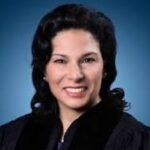
Jennifer Brunner Marilyn Zayas
Ohio’s Supreme Court used to be non-partisan. Technically. From 2007 to 2010, all of the justices were Republicans. In 2018, the Court became entirely Republican again when a Republican governor appointed a Republican justice to replace a Democratic retiree. In 2019, Ohio had a Democratic governor. In November of that year, two Democrats were elected to the Court. In 2020, a third Democrat, Jennifer Brunner, was elected to Ohio’s Supreme Court. That election gave the Court a 4-3 Republican majority.
Blaming the non-partisan election system, believing Ohioans would never elect labelled Democrats to the Supreme Court, the Republican legislature changed the rules. The new law, requiring partisan election of Supreme Court Justices, went into effect in June, 2021.
Republican legislators might have been accurate in their judgment – at least for a period of time. Republicans were elected in 2022, 2023, and 2024. Only Jennifer Brunner remains as a Democrat on the Court.
Jennifer Brunner is running for another six year term. Marilyn Zayas, who ran in 2022 but lost, is running again. If both can be elected, some partisan balance will be returned to the Ohio Supreme Court.
We are asking that Ohio as a whole to return to its recent past. Not so long ago, Ohio was as evenly divided between Republicans and Democrats as Wisconsin or North Carolina. Ohio could return to that divide. In 2026, we are urging Ohioans to elect a Democratic Governor, a Democratic Senator, a Democratic Attorney General, and these two Supreme Court Justices. I am asking you to help Ohioans to make that shift by supporting all of the Democratic candidates for those offices.
Jennifer Brunner was born in Springfield, Ohio and grew up in Columbus – state capital and home of Ohio State. Sixty-eight years old, if she is elected, this will be her last term. Ohio has an age limit of seventy for supreme court justices. A 70 year old may not be appointed or elected to the Court, but a justice who turns 70 may complete his or her term. Jennifer Brunner went to a public high school in Columbus, graduated from Miami of Ohio, and earned her JD from Capital University Law School.
Jennifer Brunner went to work for the Secretary of State’s office after her law school graduation in 1982. In November of that year, Sherrod Brown was elected Secretary of State for Ohio. During his administration, she became deputy director and legislative counsel to the General Assembly. After Sherrod Brown’s first term as Secretary of State, Jennifer Brunner left state service and entered private practice on her own. Using what she had learned in the secretary of state’s office, she represented politicians, usually on issues involving campaign law ranging from redistricting to campaign finance. She also represented people supporting or opposing referenda.
By the early nineties, Jennifer Brunner had become a sufficiently important figure that she was appointed to a variety of state commissions. In 2000, she was appointed as a judge in the Franklin County (Columbus) Court of Common Pleas and then was elected to that court in 2002. She resigned from this position to run for Secretary of State in 2006 and was elected by a 55-40 margin.
As Secretary of State, through her Grads Vote program, she encouraged high school seniors to register to vote. She also took seps to encourage members of the military and others overseas to register and vote. She addressed issues regarding voting machines that would incite Donald Trump’s imagination if he were thinking about such things at the time.
Faced with a system that allowed local election officials to take voting machines home, she prescribed how voting machines could be stored. She insisted that if machines were moved bipartisan teams were responsible. Aiming at the 2008 general election, she recommended the state replace voting machines with scannable and countable paper ballots. Funding was never provided. Currently, Ohio uses updated voting machines.
(Here is an aside I cannot resist)
Of the more than 8 million Ohio registered voters prior to the 2008 general election, nearly 700,000 were newly registered voters or had provided new information during that year. An investigation found that almost one third of those registering provided social security numbers or numbers for their driver’s licenses that did not match the government’s information about them. Perhaps they did not remember the correct number or their hand-written numbers were unreadable.
The federal Help America Vote Act (HAVA) requires states to take further steps to check on failures to match those numbers. That law was passed in 2002 in reaction to a variety of errors in Florida voting two years earlier when George W Bush was elected president by the US Supreme Court. The statute encouraged states to replace punch card and levered voting machines and to eventually create a national system of testing, certifying, and decertifying voting systems (not individual voters or votes.).
Now consider Donald Trump’s 2025 and 2026 desire to get detailed voting registration information from states and Elon Musk’s 2025 DOGE effort to obtain everyone’s personal records while supposedly making the federal government efficient. Does Donald Trump have plans for detecting and matching governmental identification numbers against the numbers provided for voting by every individual voter?
(Back to Jennifer Brunner).
In 2010, Jennifer Brunner ran for the United States Senate. If she had won, she would have been a colleague of her former boss Sherrod Brown. She lost in the primary to the candidate supported by the DSSC Chair – Senator Bob Menendez. She spent the next few years as she had previously when out of office – serving on commissions. In 2014, she ran for the 10th District Court of Appeals and was elected for that Franklin County (Columbus) position.
In 2020 Jennifer Brunner ran for the Ohio Supreme Court position she now holds. She won by a 55-45 margin. In 2022, she lost a race for Chief Justice, for which she did not have to give up her seat. Help Jennifer Brunner remain on the Court for another six year term. Make certain there is a Democratic presence on the Ohio Supreme Court.
Marilyn Zayas-Davis went to Brooklyn Tech High School and City University of New York where she had a concentration in computer science. She was born in East Harlem of parents who were from Puerto Rico and spoke little English. Her dad worked in a printshop. Her mom was a seamstress in a garment factory. Marilyn Zayas-Davis had to pass a competitive exam to get into Brooklyn Tech. Her computer 1988 science degree helped her get out of town.
Proctor and Gamble offered her a job. She worked for them in Cincinnati as an IT manager from 1988 to 1994. Then she went to law school. She was on her own from 1997 to 2000 and created her firm, MZD Law, focusing on immigration and naturalization law until 2016.
In 2016 Marilyn Zayas-Davis was elected to Ohio’s First District Court of Appeals, the first Hispanic to join an Ohio Appeals Court. She was reelected for a full term in 2018. In 2022, she ran for election to the Ohio Supreme Court, the same year that Jennifer Brunner ran for Chief Justice. Grant this to the Ohio voters. They were unprejudiced in their support for the Republican judicial candidates. Jennifer Brunner and Marilyn Zayas were each limited to 43.9 percent of the vote.
In 2026 Marilyn Zayas is running against Associate Justice Dan Hawkins. Hawkins was elected in 2024 to complete the remaining two years of the Associate Justice term vacated by the newly elected Chief Justice. Dan Hawkins tells Ohio voters two things.
- The Republican majority on the Ohio court are “justices who believe it’s the court’s role to interpret the law — not to make the law, not to legislate from the bench,”Pardon my skepticism, but we have not had a more activist court, a court more willing to change the law, more willing to change the law without thoughtful argument because they use the shadow docket to force change than the current US Supreme Court, the example for all Republican dominated state supreme courts.
- He criticized you and me (at least those of us who do not live in Ohio). “Why should somebody [from out of state] care about the Ohio Supreme Court?” ….[W]hen they can’t win the executive offices or the legislative offices, then they try to take over the court system…”. I care about every state supreme court because I care about the rights of Americans. It does not matter that I lived in Ohio for a year. It would not matter if I only traveled through Ohio to get to Illinois. We should all care about all Americans.
On the Appeals Court, even though she originally came from New York, Marilyn Zayas has earned the respect of her colleagues. She serves on two committees of the Ohio Supreme Court — The Board of Character and Fitness and the Ethics, Professionalism, and Diversity Committee, Help put her on the Ohio Supreme Court itself. DONATE.
Other State Supreme Court Races
Wisconsin Chris Taylor has an election scheduled on April 7 . DONATE NOW. There really is not a moment to lose. A victory here will shift Wisconsin’s Court to 5-2 Democrat. See Len’s Political Note #731
Arkansas John Adams has an election scheduled on March 3. DONATE NOW. Give a boost to the rare Democratic candidate for an Arkansas Court seat. Right now, the Arkansas Court is entirely composed of Republicans.
Montana. Amy Eddy if reelected will keep the Montana Supreme Court with 4 justices proud of being non-partisan and 3 justices identified as conservative. DONATE See Len’s Political Note #749
North Carolina Anita Earls if reelected will keep remain one of two North Carolina Supreme Court Democrats. There are 5 Republicans. DONATE. See Len’s Political Note #787
Other Ohio Races
Governor – Ohio Health Director during the Pandemic. DONATE. See Len’s Political Note #724
Attorney General – Retired Attorney John Kulewicz. DONATE. See Len’s Political Note #775
US Senator – Return Sherrod Brown to the Senate. DONATE. See Len’s Political Note #750
US House of Representatives – all vulnerable incumbents
Ohio 01. Cincinnati based Greg Landsman DONATE. See Len’s Political Note #766
Ohio 09. Toledo based Marcy Kaptur. DONATE. See Len’s Political Note #718
Ohio 13. Akron based Emilia Sykes. DONATE. See Len’s Political Note #72